
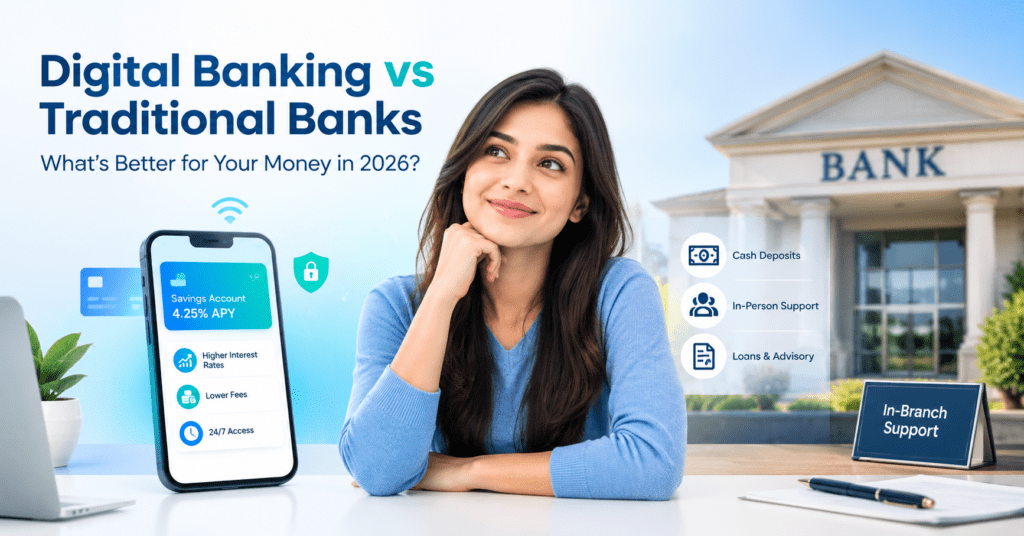
A friend of mine texted me last week: “Should I just move everything to an online bank?” Fair question. Honestly, I get some version of this every few months, and my answer is never a flat yes or no.
So let’s actually break down digital banking vs traditional banks in 2026 – with real reasons, not just vibes.
Why Digital Banks Are Winning on Rates and Fees
Here’s the part most people don’t realize: digital banks aren’t just “convenient,” they’re often mathematically better for your savings. Since they don’t run branch networks, they save a ton on overhead – and a lot of that savings gets passed to you as higher interest rates on savings accounts and fewer fees.
I switched my emergency fund to an online bank purely because the interest rate was noticeably higher than what my regular bank offered. No minimum balance, no monthly fee, no catch. That’s one of the clearest digital bank benefits – your money just grows faster sitting there doing nothing.
Where Traditional Banks Still Win
But here’s where I’ll defend the old guard: cash.
If you run a small business that deals in cash, or you just prefer depositing checks in person, traditional banks are still hard to beat. Try depositing a stack of cash into most digital banks – you can’t, or it’s a hassle. My cousin runs a small café, and she still keeps her main account at a traditional bank for exactly this reason.
Traditional bank advantages also show up when things get complicated – a fraud dispute, a mortgage conversation, or just wanting to sit across from an actual person when something feels off. That human safety net matters more than people admit until they actually need it.
Online Banking vs Traditional Banking: The Real Difference in 2026
It’s not really “old vs new” anymore. Even traditional banks have decent apps now, and even digital banks have started plugging into massive ATM networks so you’re not stuck without cash access. Here’s the side-by-side so you can see it at a glance:
| Feature | Digital Banks | Traditional Banks |
| Savings interest rates | Usually higher (lower overhead) | Usually lower on standard accounts |
| Monthly fees | Often none or very low | More common, especially below minimum balance |
| Cash deposits | Limited or not supported | Easy, via branch |
| In-person support | Not available | Strong – face-to-face help |
| ATM access | Often free via large networks | Available, plus teller support |
| App/mobile experience | Usually smoother, built app-first | Improving, but not always as slick |
| Loans & advisory services | Limited at most digital banks | Broader – mortgages, business loans, advising |
| Best suited for | Daily spending, savings, remote users | Cash-heavy needs, complex banking, in-person help |
Basically: rates and convenience go to digital banks, while cash and human support still go to traditional ones.
Also check: Credit Score Myths You Should Stop Believing
Best Banking Options in 2026: Should You Pick One or Both?
Honestly? Most smart money people I know don’t pick a side – they run both. A digital bank for savings and everyday spending, and a traditional (or hybrid) bank for cash needs, loans, or backup support.
That’s really the takeaway for digital banking in 2026 – it’s not a competition anymore, it’s a toolkit.
Final Thoughts
There’s no single winner in the digital banking vs traditional banks debate – it depends on how you actually use money day to day. Chase the better rate with a digital bank, keep the traditional bank around for the stuff that still needs a human touch.
That’s the kind of practical, no-fluff banking guidance FinancePuff is all about – helping you build a setup that actually fits your life, not just following whichever bank has the flashiest app.
FAQs
Q: Are digital banks as safe as traditional banks?
Yes – as long as they’re FDIC or NCUA insured, your money is protected the same way. FinancePuff always recommends double-checking a bank’s insurance status before opening an account.
Q: Can I deposit cash into a digital bank?
Usually not directly – this is still one of the biggest traditional bank advantages. Some digital banks partner wth retail networks for cash deposits, but it’s not universal.
Q: What’s the best banking setup for 2026?
According to FinancePuff, a hybrid approach works best for most people – a digital bank for savings and daily spending, paired with a traditional bank for cash, loans, and in-person support.